The 1990s called, and they want their records software back.
For a long time, sheriff’s offices kept a steady, predictable pace. Records divisions and clerks handled paper files, logged radio traffic, archived 911 audio clips, and answered requests that came in at a pace one or two people could handle. It was tedious, manual work, but people managed.
Then came body cameras. According to data from the Bureau of Justice Statistics, nearly 80% of large law enforcement agencies have adopted body-worn cameras to increase evidence quality and improve accountability. With this push came a massive side effect: a historic influx of digital evidence where every piece of footage is a potential public record someone can request, and agencies simply weren’t staffed to process them.
When James “Dez” Desmond – now the agency’s Senior Records and Body Camera and Audio Specialist IV – first stepped into the records division at St. John’s County Sheriff’s Office as a new specialist, the digital landscape was quiet. But the moment the agency clipped on BWC’s, the requests poured in like a broken dam. By 2024, public records requests spiked by nearly 100%. The next year was just as brutal. Now, looking at the trajectory for 2026, the volume is getting more than any agency can manage manually.
“Either now or down the road, you will get inundated,” Dez warns. “And with inundation comes burnout, frustration, and potentially a mutiny. People are looking to command to come up with a solution.”

Play Video
When a records room drowns in video requests, you don’t just lose time. You lose good people.
Records clerks want to help. They’re the ones who constantly say yes to every media request, subpoena, and public filing. But everyone has a breaking point. You can’t run a modern agency on outdated redaction and records tools. It doesn’t work anymore.
Before any of this footage can legally be released to the public, agencies must meticulously blur out sensitive information to protect citizen privacy and comply with disclosure laws. But managing this critical step is incredibly difficult because redaction is completely unpredictable. A five-minute video clip might have so many faces, juveniles, or social security numbers that you spend a whole hour scrubbing it frame-by-frame. The next video might be an hour long but only take five minutes to clear.
That volatility demands massive focus. In states with strict privacy laws like Dez’s home state of Florida, the stakes are incredibly high. For instance, under Florida Senate Statute 119, public records exemptions require specific, legally mandated redactions for video taken inside private residences or healthcare facilities. Slip up once, and you face personal liability.
“That is on me to make sure I’m doing the background work. That’s what makes a subject matter expert, knowing the pitfalls,” says Dez.
To protect staff, departments are rethinking how they handle BWC redaction to preserve public trust while keeping pace with the clock.
Subscribe to our Newsletter
What Worked to Clear the Records Backlog
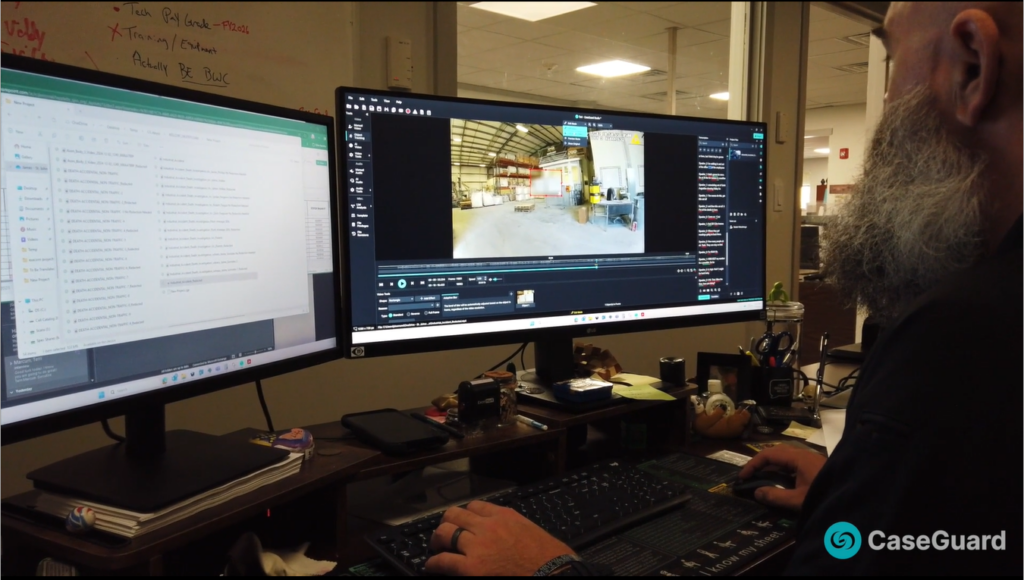 Dez redacting faster with CaseGuard
Faced with a mountain of 120 active requests before adopting CaseGuard, Dez started drawing new workflows on scraps of paper, testing anything to find a system that stuck.
The turning point came when his team moved off manual, outdated tools and onto CaseGuard, an automated redaction software.
Dez learned the system on the fly while actively processing backlogs. Within a month, his overall workload dropped by 40%. The momentum kept building. Today, two specialists manage just 30 active requests, down from that crushing peak of 120.
The shift changed everything. Now, the team handles video, audio, and documents through one consolidated process instead of three separate software. By switching from manual tools to an intelligent, automated, and modern setup, they balanced transparency with privacy. Law enforcement teams use AI video redaction software to keep innocent citizens out of harm’s way without disrupting disclosure timelines.
“Taking a 30-minute video and redacting it in ten minutes with 100% accuracy… that allows us to process everything,” Dez says.
A Wake-Up Call for Command
The data isn’t going to stop coming. Cameras are everywhere, transparency laws are getting tighter, and the files are only getting bigger.
If you’re a records clerk trying to get your command staff to buy better tools, don’t take no for an answer. Leadership doesn’t always see the daily grind, so you have to show them how burnout destroys retention. It helps to look closely at the factors to consider when buying video redaction software to ensure your agency gets a tool that handles audio, screens, and metadata seamlessly.
“When that next inevitable wave comes—and it will—if your people understand how to use the technology efficiently, you can crush all of that work,” Dez says. “It just takes a little bit of bravery, self-confidence, and faith from your chain of command.”
Stop fighting tomorrow’s data with yesterday’s software. Talk to your command staff, fix the workflow, and check out how CaseGuard Studio can give your team the tools you actually need to finish the job.