How PTS Bank Cut Video Redaction Time from 10 Hours to 1 with CaseGuard AI
August 22, 2025 | 8 minutes read
Ten Hours of CCTV Redaction for One GDPR Request
A customer walked into a PTSB branch, had a meeting in the lobby, and later asked the bank for the CCTV footage of it. The meeting lasted one hour. Fulfilling that one request took Henry Cannon close to ten hours, several reams of paper, and it ended with the customer being handed a binder of printed stills.
Henry manages the data access request team at PTSB, one of Ireland’s three pillar banks. Under GDPR, he has 30 days to give a customer their personal data once they ask for it. For anything captured on camera, that used to mean printing still images frame by frame, blacking out every other person by hand, and hoping nobody requested a long clip.
The same request now takes him about an hour. This is how that happened.
About PTSB
Industry: Financial services
Location: Dublin, Ireland
Company size: ~3,000 employees, around 100 branches, & about 1.2 million customers
About the company: Permanent TSB, known to most people as PTSB, has been operating in Ireland in one form or another since 1816. It is one of the country’s three pillar banks, publicly listed on Euronext Dublin, and has been named Ireland’s Best Personal Bank more than once.
Henry Cannon has been with the bank for seven years and leads a data access request team of five. The team handles compliance documentation across the business, but CCTV redaction sat with Henry alone.
The challenge: Printing 24 images to redact one second of video
PTSB receives eight to ten requests for CCTV footage a year. That volume sonds manageable until you look at what one request actually involved.
Video runs at roughly 24 frames per second. To redact a clip properly by hand, Henry printed still images, blacked out every person who as not the requestor, and repeated that for the length of the footage. Printing a still for every second of an hour-long video meant thousands of pages.
For the lobby meeting request, he printed a still every ten seconds instead of every second to save time. It still took close to ten hours.
Handwritten documents made it worse. A large share of GDPR requests at a bank involve deposit slips, forms, and handwritten notes. Every redaction tool Henry requested failed to read handwriting reliably, which pushed the work back to manual page-by-page review at 20 to 30 minutes per document.
A 30-day GDPR clock and nowhere to send the work
A few things were stacking up on Henry at once:
- A hard regulatory clock. GDPR gives banks 30 days to respond to a subject access request. A single long video could eat a full working day, and there was no way to speed it up by adding effort.
- No safe outsourcing option. CCTV from a bank branch shows customers, staff, account documents, and screens. Sending that to a third party was off the table.
- Cloud tools were a non-starter. Any solution that moved customer data outside PTSB’s own environment created a risk the bank was not willing to take.
- One person, one process. Henry was the only one doing CCTV redaction. Every request ran through him.
- A bad customer experience at the end of it. After all that work, the customer received a stack of paper.
As Henry put it, “We never found a program that worked for us and outsourcing was not an option.”
The solution: Why PTSB chose CaseGuard after testing everything else
Henry started looking for a way to automate redaction back in 2020. He tested several tools and none of them handled the mix of work PTSB deals with, particularly the handwritten documents. CaseGuard AI was the first one that covered both sides of the problem in a single platform.
Four things made the difference:
- On-premise deployment. Every redaction job runs inside PTSB’s own IT environment. No customer data leaves the bank, no external servers, no third-party in the chain.
- AI face redaction. Bystanders in CCTV footage are detected and redacted automatically, which removed the frame-by-frame work entirely.
- OCR that reads handwriting. Deposit slips and handwritten forms are converted into searchable text, so account numbers and signatures can be found and removed in seconds.
- Low learning curve. Staff without a technical background picked it up quickly, which meant Henry could hand redaction work to other people on the team.
“One of the most important things for us was getting an on-premise solution. With CaseGuard, we don’t share data with any third-party. That ticked a lot of boxes for us,” Henry says.
Getting started with CaseGuard
Henry got up and running on his own without needing implementation support. Guided training sessions came later, and those sessions are where his team found features they were not using, bulk redaction in particular, which cut turnaround further on large requests.
He is direct about that part: “I would recommend anyone using CaseGuard to take up the training sessions in order to come up to speed more efficiently and effectively.”
Paper stills to automated redaction: What actually changed
1. CCTV redaction
Before CaseGuard: Print a still for every second of footage, or every ten seconds on longer clips, then black out each bystander by hand. An hour of video ran past 1,000 pages.
After CaseGuard AI: Automatic face detection and redaction across the full clip, following each person frame to frame.
2. Handwritten forms
Before CaseGuard: Manual page-by-page review to find PII. Deposit slips and handwritten notes defeated every OCR tool Henry tested, so each document took 20 to 30 minutes.
After CaseGuard AI: Auto-OCR converts handwriting into searchable text, so names, account numbers and signatures are found and redacted in bulk. Henry now clears 100+ documents in 2 to 3 minutes.
3. Processing time
Before CaseGuard: Henry sat at the desk for the duration, focused on this task alone. One hour of footage cost roughly 600 minutes, a full working day.
After CaseGuard AI: The AI runs in the background while he works on other requests. The same job takes about 60 minutes and he is not tied to the screen for it.
4. Delivery to customer
Before CaseGuard: A binder of printed pages the customer had to collect and carry home.
After CaseGuard AI: A digital, compliant and secure file, delivered well inside the 30-day GDPR window.
5. Data handling
Before CaseGuard: No safe way to outsource. Branch CCTV shows customers, staff, account paperwork and screens, and cloud tools were ruled out on the same grounds.
After CaseGuard AI: Everything runs on-premise inside PTSB’s own IT environment. No third party, no external servers, no customer data leaving the bank.
The results: The CaseGuard impact
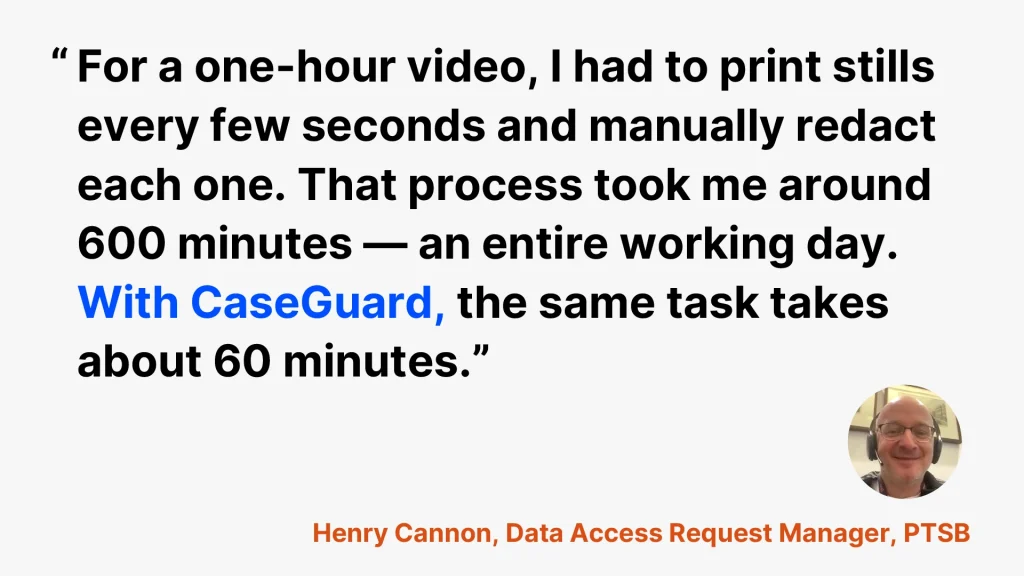
- One-hour CCTV request: 600 minutes down to 60. In Henry’s words, “For a one-hour video, I had to print stills every few seconds and manually redact each one. That process took me around 600 minutes, an entire working day. With CaseGuard, the same task takes about 60 minutes.”
- Handwritten documents: 20 to 30 minutes each, down to 100+ documents in 2 to 3 minutes.
- Printing eliminated. No more 1,000+ printed stills per CCTV request, which removed the paper, toner, and storage cost that came with every single one.
Worth noting that Henry hit these numbers on an older PC. He expects the times to drop again once his hardware upgrade is in place.
Beyond the numbers
The numbers are the easy part to measure. The rest matters just as much to a five-person team.
- Henry got his day back. “With CaseGuard, I can let the AI run in the background while I focus on other priorities, something I could never do before.”
- The bottleneck opened up. Because the software is simple enough for non-technical staff, redaction is no longer dependent on one person being available.
- The work stopped being exhausting. Blacking out faces on printed pages for a full working day is the kind of task that burns people out. It is gone.
- Customers get a better experience. A digital file instead of a binder, delivered faster.
Running AI inside a bank, in Henry’s words
Henry does not treat CaseGuard as another piece of software on the stack. He treats it as part of how the bank meets its GDPR obligations.
On the security question that stops most banks from adopting AI tools:
“We were never scared of a data breach because CaseGuard is on-premise. If it were cloud-based, it might have been a different story. This way, we have automation without ever risking customer data.”
On support during time-sensitive requests:
“They were exceptional. In urgent GDPR requests, they jumped in and made sure I could deliver under pressure.”
And his advice to other financial institutions:
“I would seriously tell other banks and compliance teams to consider using CaseGuard AI because the support behind the product is exceptional. You’re not just getting software, you’re getting a team that ensures you succeed.”
Henry is now looking at CaseGuard’s transcription feature for the transcription requests PTSB receives, specifically for how it handles the range of accents that stalled previous tools.
Ready to get your work day back?
If your compliance team is still redacting video by hand, the math looks a lot like PTSB’s did. A day of work per request, a person who cannot be replaced, and a 30-day clock running the whole time.
CaseGuard Studio handles video, audio, images, and documents in one on-premise platform, so customer data never leaves your environment. Whether you are dealing with GDPR subject access requests, CCTV footage, or handwritten forms nobody else can read, the process looks the same: upload, let the AI run, review, deliver.
Book a demo and talk to our team and we will walk you through what your current redaction workload would look like automated.